Peptides in 2026: The Plain-English Guide to Skincare, Collagen, GLP-1s and Injectable Peptides
Last reviewed: July 22, 2026
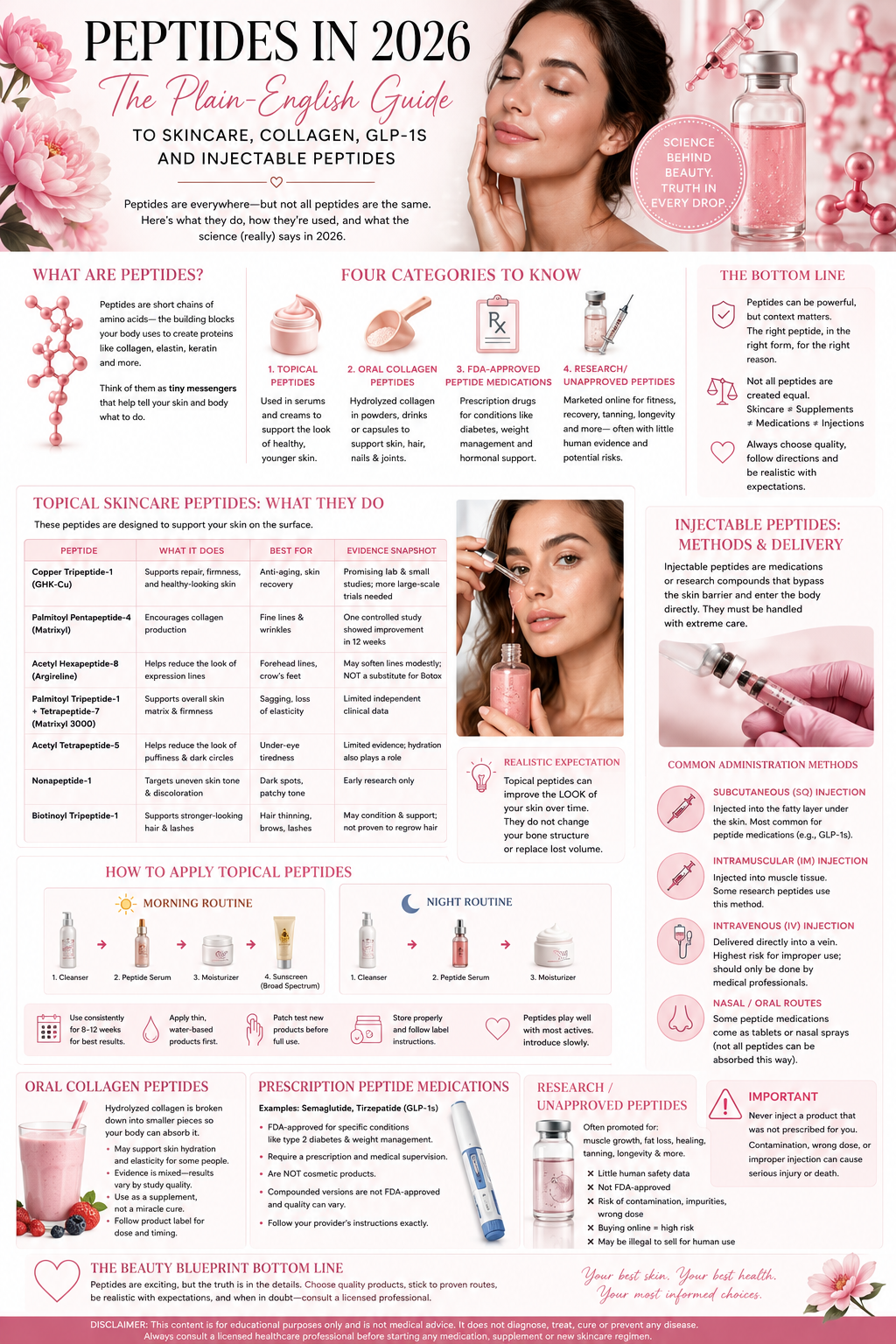
Peptides are everywhere in 2026. You will find them in anti-aging serums, eye creams, scalp products, collagen powders, prescription weight-management medications and online “research” injections.
The confusing part is that all of these products use the word peptide, even though they may work very differently and carry completely different levels of risk.
A peptide is simply a short chain of amino acids. Amino acids are the small building blocks the body uses to make larger proteins such as collagen, elastin and keratin. Some peptides act as messengers, some carry minerals, some influence hormones and others are digested as nutrition. Calling something a peptide does not automatically mean it is effective, natural, safe or appropriate for self-treatment.
Important: This article provides general beauty and health education. It does not diagnose conditions, prescribe treatments or provide instructions for mixing, dosing or injecting medication.
The four peptide categories consumers should understand
1. Topical cosmetic peptides
These are ingredients placed in serums, moisturizers, masks and eye products. They are intended to improve the appearance of the skin.
2. Oral collagen peptides
These are collagen proteins broken into smaller pieces so they can be mixed into powders, drinks, gummies or capsules.
3. FDA-approved peptide medications
These are prescription drugs studied and approved for specific medical conditions. Depending on the product, they may be injected, swallowed or administered by another approved route.
4. Unapproved or “research” peptides
These are products sold online or by some wellness clinics for healing, tanning, muscle gain, metabolism, sleep or longevity. Many have little human evidence and no FDA-approved use.

Part One: Peptides in skincare
Skincare peptides are often described as little “messages” that encourage the skin to behave in a certain way. Researchers commonly group them into four broad types:
- Signal peptides are intended to support the production or maintenance of components such as collagen.
- Carrier peptides transport trace elements such as copper.
- Neurotransmitter-inhibiting peptides are designed to reduce some of the signaling involved in facial movement.
- Enzyme-inhibiting peptides are intended to slow enzymes that contribute to the breakdown of important skin components.
A major limitation is delivery. Peptides can be unstable, water-loving molecules that do not always pass easily through the skin’s outer barrier. The complete formula, delivery system, packaging and stability may matter as much as the peptide’s name.
The most common cosmetic peptides
| Ingredient | What it is intended to do | Plain-English evidence note |
|---|---|---|
| Copper Tripeptide-1 or GHK-Cu | Supports the appearance of repair, firmness and healthier-looking skin | Promising laboratory and small human studies, but claims are often stronger than the clinical evidence |
| Palmitoyl Pentapeptide-4 | Supports collagen-related skin structure; often sold as Matrixyl | Some controlled research suggests modest improvement in fine lines |
| Palmitoyl Tripeptide-1 + Palmitoyl Tetrapeptide-7 | Commonly called Matrixyl 3000; used for firmness and wrinkles | Frequently used, but independent clinical evidence is limited |
| Palmitoyl Tripeptide-5 | Marketed to support firmer-looking skin | Biologically plausible, but large independent trials are limited |
| Acetyl Hexapeptide-8 | Marketed for expression lines; commonly called Argireline | May modestly soften the appearance of movement-related lines, but it is not topical Botox |
| Acetyl Tetrapeptide-5 | Used in under-eye products for the appearance of puffiness | Evidence is limited; hydration and light reflection may contribute |
| Nonapeptide-1 and Oligopeptide-68 | Used in brightening products | Early evidence only; they should not be presented as treatments for pigment disorders |
| Biotinoyl Tripeptide-1 and Acetyl Tetrapeptide-3 | Included in scalp, brow and lash products | May condition hair and scalp, but are not proven to regrow hair like approved medications |
| Carnosine | Used for antioxidant and anti-glycation claims | Interesting laboratory evidence; visible results depend on the finished formula |
Copper peptides: topical and injectable are not the same
Topical Copper Tripeptide-1, or GHK-Cu, is commonly used in cosmetic serums. Laboratory research suggests it may influence collagen-related activity, inflammation and skin-repair processes, although large independent clinical trials remain limited.
Injectable GHK-Cu is a completely different risk category. A cosmetic serum should never be injected or pushed beneath the skin with a home injection device.
Is Argireline really “Botox in a bottle”?
No. Acetyl Hexapeptide-8 is designed to influence part of the signaling associated with facial movement. A topical cosmetic cannot reach or temporarily paralyze a muscle in the same controlled manner as an injected prescription neurotoxin.
The realistic expectation is a possible modest softening in the appearance of expression lines when the product is well formulated and used consistently.
How to apply a topical peptide product
Morning
- Gently cleanse the skin.
- Apply the peptide serum according to its label.
- Apply moisturizer.
- Finish with broad-spectrum sunscreen.
Evening
- Remove makeup and cleanse.
- Apply the peptide serum or peptide moisturizer.
- Finish with moisturizer when needed.
Apply thin, water-based products before heavier creams. Most peptide studies evaluate regular use over several weeks, not a few nights.
Patch testing
Test a small amount on a limited area first. Stop if persistent burning, swelling, blistering or a worsening rash occurs. Peptides themselves may be gentle, but fragrance, preservatives, acids or botanical extracts in the same formula can still irritate the skin.
Can peptides be used with vitamin C or retinoids?
There is no universal rule that every peptide must be separated from vitamin C, retinoids or exfoliating acids. Follow the label, introduce one new active at a time and separate strong products into morning and evening routines if irritation develops.
Peptides and microneedling
Do not assume that an ordinary cosmetic serum is safe to place into freshly needled skin. Everyday skincare products are not necessarily sterile or designed for delivery beneath the skin barrier.
Part Two: Oral collagen peptides
Collagen powder is called a peptide product because the original collagen protein has been broken into smaller fragments. After you swallow collagen peptides, the digestive system breaks them down and absorbs them. The body decides how those amino acids and fragments are used.
The evidence is mixed. Some trials report modest improvements in hydration and elasticity, while higher-quality reviews have raised concerns about small studies, inconsistent products and industry funding.
The balanced conclusion: collagen supplements may produce a modest benefit for some people, but the result is not guaranteed. Treat them as an optional nutrition product—not a replacement for sunscreen, adequate protein, skincare or medical treatment.
How oral collagen is taken
Collagen peptides are sold as powders, ready-to-drink liquids, capsules and gummies. Use the product according to its label rather than assuming more is better. Check whether the collagen comes from fish, cattle, pigs or poultry when allergies or dietary restrictions matter.
Part Three: Prescription peptide medications
Some of the most important medicines in healthcare are peptides. Insulin is a classic example. Popular GLP-1 medications also belong to this broader family.
Semaglutide and tirzepatide
Semaglutide and tirzepatide are prescription medications with FDA-approved products for specific diabetes and weight-management indications. They affect appetite, digestion, blood sugar and other metabolic processes.
They are not general anti-aging serums or beauty injections. Any appearance change caused by weight loss is an indirect result of the medical treatment, not proof that the medication directly rejuvenates skin.
Retatrutide and other investigational products
Some peptide drugs discussed online may still be investigational or unapproved. A product labeled “research use only” should never be interpreted as an approved medication for self-treatment.
Yes—injection is included as an administration method
Peptide medicines can be administered in several ways, depending on the specific product. Injection is one of those methods, but it is not the only one.
- Subcutaneous injection: Delivered into the fatty layer beneath the skin. Many approved peptide medicines use this route.
- Intramuscular injection: Delivered into muscle tissue. Some medicines and some research settings use this route.
- Intravenous administration: Delivered directly into a vein and generally performed in a medical setting.
- Oral tablets or capsules: Some peptide-based medicines or peptide products are swallowed.
- Nasal or other approved routes: Certain products may use a nasal spray or another route specifically tested for that medication.
The correct route, dose, preparation and timing must come from the official product labeling, prescriber and pharmacist. This article intentionally does not provide mixing, reconstitution, needle-size, injection-site or dosing instructions.
Part Four: Viral “research peptides”
This is the category where consumers need the greatest caution. Online sellers may advertise peptides for injury recovery, muscle growth, fat loss, tanning, sleep, anxiety, brain performance, sexual health, anti-aging or longevity.
The phrase “research use only” does not make a substance safe for people. Injectable products are especially concerning because they bypass protective barriers and can introduce contamination directly into the body.
| Peptide | How it is promoted | What consumers should know |
|---|---|---|
| BPC-157 | Tendon, gut or injury healing | Human safety and effectiveness evidence is inadequate for self-treatment |
| TB-500 | Recovery, mobility and tissue repair | Very limited human exposure data |
| CJC-1295 and Ipamorelin | Growth hormone, fat loss, muscle or anti-aging | Limited human evidence and meaningful safety uncertainty |
| MOTS-c and Epitalon | Metabolism, energy, sleep or longevity | Insufficient human safety information for marketed uses |
| Injectable GHK-Cu | Skin repair, hair and anti-aging | Not the same as a cosmetic serum; injectable safety data are limited |
| Semax and Selank | Focus, cognition, calm or anxiety | Important evidence and regulatory gaps remain |
| Melanotan II | Rapid tanning | Associated with serious safety concerns and should not be treated as a cosmetic shortcut |
Why online peptide vials are risky
A vial may contain a different ingredient from the label, too much or too little of the stated peptide, bacterial or fungal contamination, endotoxins, particles, residual manufacturing chemicals or a product damaged by heat during shipping.
Peptide red flags
- Calls an unapproved injectable “clinically proven”
- Says a compounded drug is the same as an FDA-approved drug
- Sells injections without a legitimate medical screening
- Provides no access to a licensed prescriber
- Ships a refrigerated drug warm
- Uses “research use only” while giving human dosing directions
- Requires home mixing without professional support
- Promises rapid tanning, healing, muscle growth and anti-aging from the same product
- Uses testimonials instead of controlled human studies
- Will not identify the dispensing pharmacy or manufacturer
Frequently asked questions
Are topical peptides generally gentler than retinoids?
Many peptide products are formulated to be gentle, but the complete formula determines whether a product irritates the skin.
Can a peptide cream rebuild lost facial volume?
No topical cosmetic has been shown to replace facial fat, filler or surgically reposition tissue. A peptide moisturizer may make skin appear smoother, more hydrated or firmer.
Do peptide serums cause “purging”?
Peptides do not normally speed skin-cell turnover in the same way as a retinoid or exfoliating acid. Breakouts may result from another ingredient, irritation or the richness of the formula.
Can topical peptides replace sunscreen?
No. Peptides may support the appearance of the skin, but they do not replace broad-spectrum sunscreen.
How long should a topical peptide be tried?
Unless irritation occurs, consistent use for about eight to twelve weeks is a more realistic test than a few days. Compare photographs in similar lighting.
Are peptides safe during pregnancy?
There is no single answer for every peptide or formulation. Pregnant or breastfeeding customers should show the full ingredient list to their obstetric or dermatology professional. Prescription, compounded and injectable peptides require individual medical review.
The Beauty Blueprint bottom line
Topical skincare peptides: Generally reasonable cosmetic ingredients with promising but uneven evidence.
Oral collagen peptides: Possibly helpful for some people, but not a guaranteed anti-aging treatment.
FDA-approved peptide medications: Legitimate medical treatments for specific conditions, used according to professional instructions.
Online injectable or “research” peptides: A high-caution category with major evidence, quality and regulatory concerns.
The best peptide product is not the one making the biggest promise. It is the one with a transparent ingredient list, realistic claims, appropriate packaging and a method of use that matches the available evidence.
Selected sources
- FDA: Understanding the risks of compounded drugs
- FDA: Bulk drug substances that may present significant safety risks
- FDA: Concerns with unapproved GLP-1 drugs
- FDA: Cosmetic labeling claims
Disclaimer: Beauty Blueprint Studio provides cosmetic education and general wellness information. This article is not medical advice and does not recommend, prescribe or endorse injectable, compounded or research peptides. Consult a licensed healthcare professional regarding medications, supplements, pregnancy, skin conditions or adverse reactions.